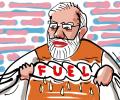
Following through announcements with enforcement of measures is key, as a run through recent Indian economic history shows, points out A K Bhattacharya.

Rating agency Moody's has placed 13 Indian banks, including State Bank of India, ICICI Bank and Punjab National Bank, on watch for possible downgrade under a global review of systemic support available for the banking sector.
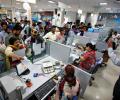
If the banks throw caution to the winds for building loan books, the hydra-headed bad loans may resurface and spoil the party, warns Tamal Bandyopadhyay.

The Reserve Bank has asked the public to pay their income tax dues well in advance so as to avoid standing in long queues and stated that 29 agency banks are also authorised to accept such payments.

Union Home Minister Amit Shah has criticised the TMC government in West Bengal, alleging that its policies have led to increased infiltration and threaten national security. He framed the upcoming elections as a battle against these issues, promising change if the BJP comes to power.

The high-pitched campaign for the first phase of West Bengal assembly elections concluded with the BJP and TMC focusing on electoral rolls and dietary habits, while making promises to voters. Voting is scheduled in 152 constituencies across north Bengal and southern districts, with over 3.60 crore electors eligible to vote. A record number of Central paramilitary forces have been deployed, and several districts have been identified as highly sensitive.
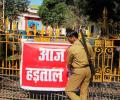
Among other demands, the unions are also seeking immediate introduction of five-day week in full and reduction of cash transaction hours and regulated working hours.

The cases pertain to State Bank of India, Punjab National Bank, Andhra Bank, Oriental Bank of Commerce, Indian Overseas Bank, Allahabad Bank, Canara Bank, Dena Bank, Punjab and Sind Bank, Central Bank of India, Union Bank of India, IDBI Bank, Bank of Baroda, Bank of Maharashtra and Bank of India.

Union Home Minister Amit Shah emphasizes the need for a unified anti-terrorism structure and a strong anti-terrorism grid across India to effectively counter terror attacks. He also announced a new plan to combat organized crime.

Public sector banks have raked in more profits in the three months ended June on the back of a persistent decline in bad loans and the trend may have a positive bearing on their balance sheets in the coming quarters. In the June quarter, Bank of Maharashtra (BoM) and State Bank of India (SBI) were in the lowest quartile as far as Gross Non Performing Assets (NPAs) and net NPAs were concerned, according to an analysis of the quarterly financial numbers published by the public sector lenders. Cumulatively, all the 12 public sector banks reported a profit of about Rs 15,306 crore in the three months ended June, registering an annual growth of 9.2 per cent. However, leading public sector lenders -- SBI and PNB -- posted lower profits in the June quarter.

AIBEA said that on April 19 its officer bearers would meet in Punjab to decide the next course of action.

'A breakout above 158,000 to 160,000 could trigger the next leg higher toward 165,000 to 170,000.'

The Supreme Court on Friday issued fresh notices to Anil Ambani and the Anil Dhirubhai Ambani Group (ADAG) on a PIL seeking a court-monitored probe into alleged massive banking and corporate fraud involving the firm and its group companies.
After upgrading India's foreign currency debt rating, Moody's Investor Service on Wednesday upgraded the foreign currency deposit, debt and issuer ratings for 11 Indian banks and financial institutions.

With the rise in interest rates, bond yields have been on the rise; this will dent banks' treasury profits. Also, many retail borrowers may find it difficult to service their loans when the loan rates rise, points out Tamal Bandyopadhyay.

The United Forum of Bank Unions (UFBU), an umbrella body of nine unions, on Tuesday gave a call for a two-day strike from March 15 to protest against the proposed privatisation of two state-owned lenders. In the Union Budget presented last week, Finance Minister Nirmala Sitharaman announced the privatisation of two Public Sector Banks (PSBs) as part of its disinvestment plan. The government has already privatised IDBI Bank by selling its majority stake in the lender to LIC in 2019 and merged 14 public sector banks in the last four years.

Mirroring the traditional hawala system, where money is sent through non-banking channels, this digital version uses the anonymity of unregulated cryptocurrency to erase the financial trail and inject cash into the domestic economy.

'We believe the truth is in the middle, and that India is at an important crossroads.'

Punjab Governor Gulab Chand Kataria emphasised the importance of Aadhaar in promoting good governance, transparency, and ease of living, highlighting its role in ensuring welfare benefits reach the intended recipients and strengthening the rural economy through Direct Benefit Transfer.

Whether he comes to power or not, both his admirers and opponents agree on one thing -- Vijay may well turn out to be the 'X factor'.

The campaign for the current election cycle ended on Monday as canvassing for the final phase in West Bengal concluded with a bitter war of words between rival parties over cross-border infiltration, corruption, unemployment and the Special Intensive Revision (SIR) of electoral rolls.

Finance Minister Nirmala Sitharaman's biggest challenge will be to find a new growth driver, particularly against the backdrop of a global economy ravaged by heightened uncertainty and fragmentation, financial markets on a precipice, and global commodity prices on a continued uptrend.

The country's largest public sector lender State Bank of India on Monday fixed its benchmark lending rate at 7.5 per cent following a Reserve Bank directive, a move that will end the practice of sub-prime loan to corporates.

As banks' chase for customers to collect cheap deposits is not fructifying, they are forced to offer inflation-beating real interest rates on fixed deposits now, and state-run banks led by Punjab & Sind Bank tops the chart offering 8-8.50 per cent per annum deposit rate. Banks are forced to offer inflation-beating deposit rates for a tenor ranging from 200 to 800 days as credit growth has been far outpacing deposit mobilization throughout this fiscal, leading to a funding crunch.

A court in Antwerp on Friday cleared the extradition of fugitive diamantaire Mehul Choksi, noting that his arrest by the Belgian authorities on India's request was valid, officials in the know of the development said.

2027's housing census trims questions but adds digital-age indicators like Internet and smartphones.

India's merchandise exports grew in the first three weeks of November compared with the same period last year, according to preliminary government data, Commerce and Industry Minister Piyush Goyal said on Tuesday. The uptick comes despite globa

TMC leader Abhishek Banerjee challenges Amit Shah to a debate on governance, accusing the BJP of political manipulation and misrepresenting West Bengal's financial situation. He also criticised the BJP's record on women's safety and alleged the Centre was withholding funds from West Bengal.

As the March 31 deadline arrives, a wave of Maoist surrenders suggests insurgency's end, but political and social concerns remain.

Kerala is set to hold its Assembly election, with the ruling LDF aiming for a historic third term, the UDF seeking a comeback, and the NDA striving to gain a foothold in the state's political landscape.

The idea of back-loading the target of fiscal consolidation is perhaps guided by the government's desire to be prepared for any adverse developments in the coming year, points out A K Bhattacharya.

Bank strike continued for day-two on Tuesday, led by nine unions of public sector banks (PSBs) in the country, opposing government's policy to privatise the lenders. Customers will be inconvenienced to get services such as cash withdrawals, deposits, cheque clearances, remittance services. Government transactions related to treasury as well as business transactions will also be impacted. United Forum of Bank Unions (UFBU), an umbrella body of nine unions, had given a strike call for March 15 and 16.
Better protection for depositors and investors was one of the chief considerations in Union Finance Minister Nirmala Sitharaman introducing, on Friday, the Banking Laws (Amendment) Bill, 2024, in the Lok Sabha to amend four pieces of legislation. This amendment is also to improve audit quality in public-sector banks (PSBs), offer consistency in reporting by banks to the Reserve Bank of India (RBI), and provide for an increase in the tenure of directors in cooperative banks.

The rally in PSBs, analysts feel, was more a knee-jerk reaction to the development, and the actual benefits will start to accrue once the addition takes place in 2024. "The actual benefit for banks from the inclusion in JP Morgan's EM Index will accrue from June 2024 onwards. "Until then, the larger fundamentals of the market will dictate the moves. "Once the initial euphoria subsides, bond markets will look to global cues which may trigger fresh selling," said Siddharth Khemka, head of retail research, Motilal Oswal Financial Services.

Amid US-China trade tensions and economic vulnerabilities, India must seize the 'China +1' opportunity, deepen reforms, secure FTAs, and globalise its firms for long-term growth, suggests Ajay Shah.

Shaheed Diwas 2026: India observes Martyrs' Day on March 23, marking 95 years since Bhagat Singh, Rajguru and Sukhdev were hanged by the British in 1931. PM Modi leads tributes. History, significance, quotes and how the nation is remembering the martyrs today.

The Enforcement Directorate (ED) is seeking an expedited trial against Congress leader P Chidambaram in the Aircel-Maxis and INX Media money laundering cases, having submitted the required prosecution sanction to the court.
Defence expenditure was pegged at 1.4 per cent of GDP in the Budget for 2025-26 but it may widen, depending on tensions between India and Pakistan.
